

Art enables us to find ourselves and lose ourselves at the same time.
That’s Thomas Merton, a contemplative thinker who grasped the paradox of art: the way it anchors while setting us free. This was the thought that came into my mind when I saw the piece entitled “Moon.” The simplicity is disarming, the complexity quietly unnerving. This artwork speaks to something both very primal, very meditative, but also quintessentially human.
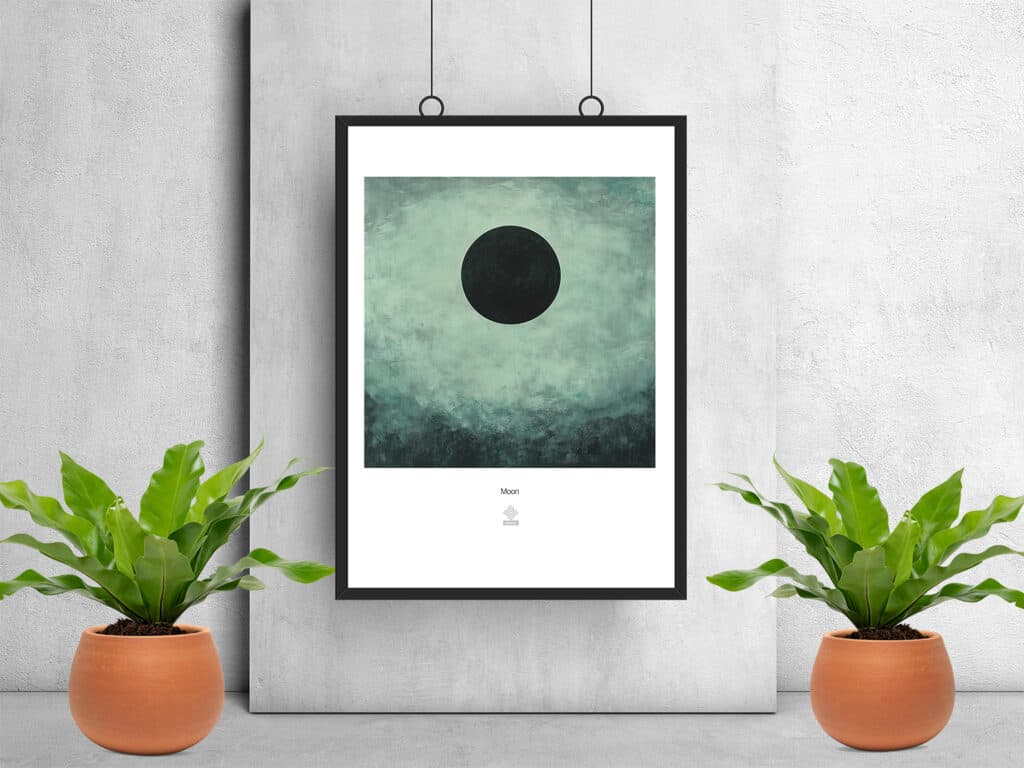
At first glance, “Moon” can easily be labelled as minimalistic. A black circle against a swirling greenish-blue void. But look more carefully and we will discover such simplicity can be deceptive in its apparent nature. The moon does not just sit on the canvas but rather hovers, pulling in all the atmosphere in a gravitational manner. That background texture defines the mood of an eternal moment.
The piece has a remarkable ability to instil a profound sense of stillness within us. You can’t glance at “Moon” and move on. The gravitational pull of the dark void insists that you stay-even if it’s uncomfortable. It is contemplative art at its best-art that doesn’t just beautify a wall but claws its way into our brain.
Now, let’s talk color. The palette isn’t loud. No bold reds or flamboyant yellows. You’re met instead with muted greens and blacks, whispering rather than shouting. And isn’t that a reflection of how we often experience life’s most profound moments? Subtle. Fleeting. Almost silent. That murky green is evocative of misty landscapes, the sort one only glimpses at dawn, before the sun has fully claimed the sky. It’s introspective and grounding.
And then there’s the title: Moon. Just a single word. Informs you just enough, yet leaves so much unsaid. Is it about the moon as a celestial entity, a metaphor for cycles, darkness, or renewal? It’s deliberately ambiguous, inviting us to project our own meaning. For me, it speaks of introspection-the part of us that thrives in solitude, under dim light, far from the noise.
What makes this piece especially interesting is its versatility. It could hang in a modern, minimalist apartment or a cozy, bohemian space filled with books and plants. The energy shifts depending on the environment, which speaks volumes about its adaptability. Yet, no matter where it’s placed, it transforms the room into a space for contemplation.
In a world obsessed with bright screens and endless scrolls, “Moon” feels like an antidote. It’s a visual pause. A reminder to stop. To breathe. To let the void speak.
If you are someone who values moments of reflection, this piece is not just decor, but a companion. It invites you into its quiet world, but not passively. You have to meet it halfway. And in that meeting, you’ll find something rare: space. Space to think, to feel, to just be.
So, here’s my challenge to you: The next time you’re in front of art, don’t rush through it. Sit with it. Let it work on you. Perhaps it will stir a memory, an emotion, or even a question you didn’t know you had. Art like “Moon” reminds us why we keep returning to galleries, why we keep putting paint to canvas-it’s not just about what we see. It’s about what we discover within ourselves.